The Controlled Demolition
Series
The Controlled Demolition
The Controlled Demolition
I've been staring at casualty reports from Iran for longer than is probably healthy. The numbers keep changing. 3,117 dead, says the Iranian government. 7,000, says one NGO. 32,000, says Trump. 43,000, says another human rights group.
The actual number doesn't matter anymore. What matters is that in January 2026, the Islamic Republic of Iran killed so many of its own people in two weeks that nobody can agree on the body count. Hospitals were overwhelmed. Morgues ran out of space. They had to tell people to stop bringing in the dead because there was nowhere left to put them.
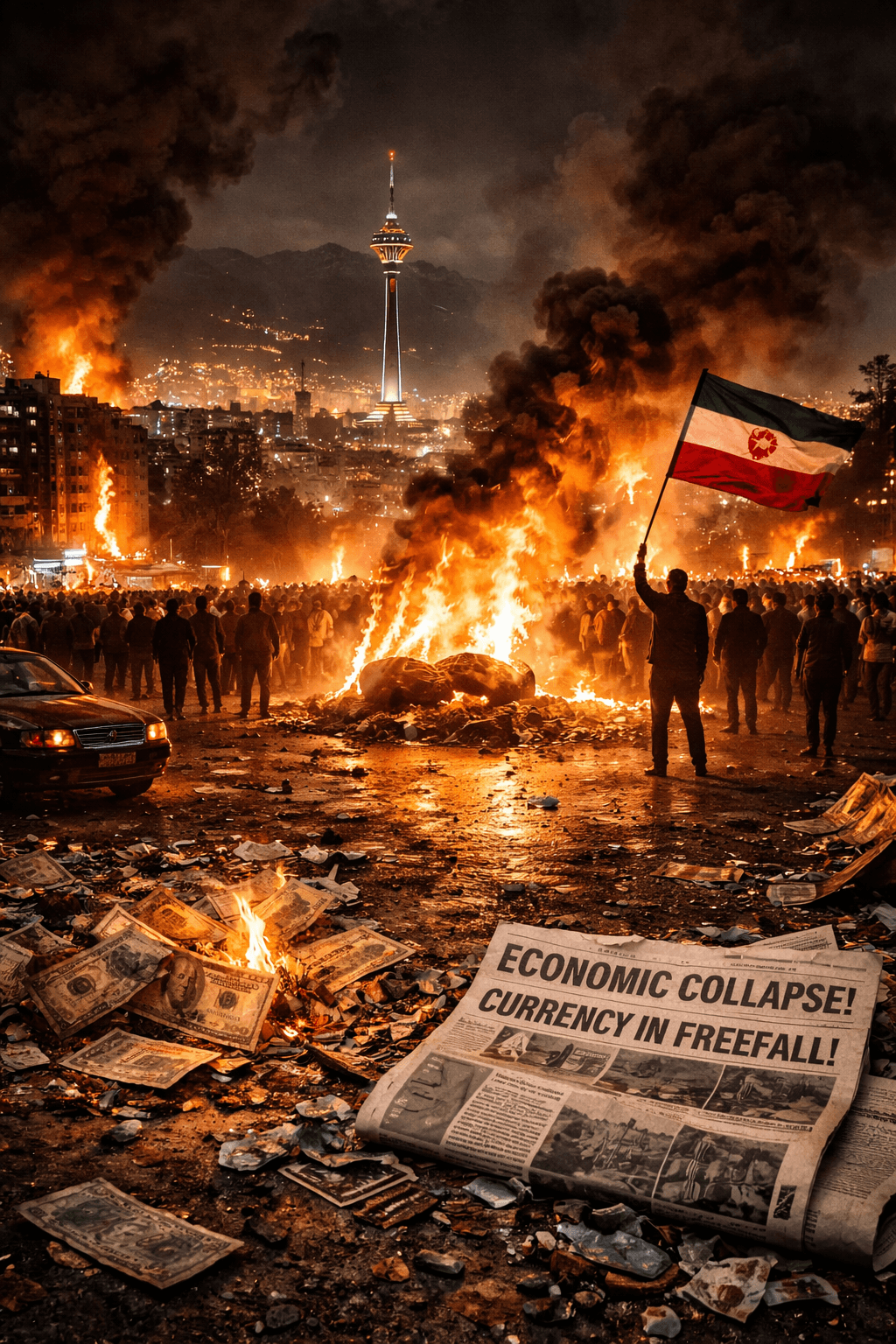
Streets in Tehran ran with blood. Security forces set buildings on fire with protesters trapped inside. They blocked fire trucks from responding. They went into hospitals and finished off the wounded. They deployed drones against crowds. Mounted machine guns on vehicles and opened fire.
And here's the thing: this wasn't strength. This was the scream of a dying regime that knew it was already over.
Making Iran Broke Again
Let me take you back about a year, to when this really started.
Scott Bessent is the US Treasury Secretary. In January 2026, he went on Fox News and Maria Bartiromo asked him about sanctions on Iran.
He gloated.
"Their economy collapsed," he said. Not "we've applied economic pressure." Not "sanctions are having their intended effect." He said collapsed. Past tense. Done.
Then he took credit for the protests. The ones where thousands of people would die a few weeks later. "Making Iran broke again will mark the beginning of our updated sanctions policy," he said, and I swear to God he was smiling.
Here's what "maximum pressure" actually looked like on the ground:
The Iranian rial went from 42,000 per US dollar to 1.4 million. A 97% loss of value. Your life savings, your salary, your pension — all worth three cents on the dollar. Some currency conversion sites started showing Iran's currency as "$0.00" because their systems literally couldn't handle numbers that small.
I keep thinking about that. A whole country's money, and the computers round it to zero.
Inflation hit 60% annually. Food prices went up 72%. Over eight years, Iranians lost 90% of their purchasing power. By 2024, 57% of the population was experiencing some level of malnutrition. More than half the country couldn't afford to eat properly. Oil exports — Iran's lifeline — were being sold through shadow fleets of tankers that turned off their tracking devices and used false flags, at massive discounts to desperate buyers who knew they had the leverage.
By late 2025, newspapers in Tehran were full of ads selling office furniture from recently shuttered companies. Businesses were dying one at a time and then all at once. The Statistical Center of Iran announced one month that the internet shutdown alone — just the shutdown — was costing somewhere between $20 billion and $90 billion in GDP loss.
This was intentional. This was the plan. Bessent said it out loud: "We will close off Iran's access to the international financial system." "We are going to shut down Iran's oil sector." "If economic security is national security, the regime in Tehran will have neither."
Three sentences. The whole strategy. I keep reading them over.
The Collapse
December 28, 2025.
The rial hit new lows. Shopkeepers in Tehran's Grand Bazaar — the traditional commercial heart of the city — shut their stores. Not as protest. Because they literally couldn't do business anymore. Prices were changing by the hour. You couldn't import goods. You couldn't price anything. The currency was moving too fast to quote.
Protests started there. With the merchants. The people who keep societies running, who usually stay out of politics because they just want to do business. When the bazaari close their shops, that's the tell. That's when you know the bottom has fallen out. It's happened before in Iran — in 1979, in 1906. The bazaaris are the canary. When they walk out, it's already over.
The protests spread. Universities. All 31 provinces. Major cities. Rural areas. Areas that were supposed to be loyal to the regime. Everyone was in the streets because everyone was starving.
And the regime looked at this and made a calculation.
They could reform. Open up. Make concessions. Negotiate. Promise change.
Or they could kill them.
They chose kill them.
The Tell
When a regime starts massacring its own population by the thousands, it's not because they're strong. It's because they're out of options.
Strong regimes negotiate. They co-opt opposition leaders. They make symbolic concessions. They release some prisoners, promise reforms, buy time. They have tools. Regimes that are weak but trying to look strong use police. Arrests. Some targeted killings. Show trials. They still have some capacity to govern.
But when you're setting buildings full of protesters on fire and blocking the fire trucks, when you're deploying drones and mounted machine guns against crowds in your own capital — you're not governing anymore. You're just trying to survive one more day through pure terror.
The IRGC and Basij went into hospitals and killed wounded protesters. They surrounded the Rasht Bazaar, set it on fire with people inside, and shot anyone trying to escape. In one girls' school — before the US even struck — they killed students and left the bodies.
There's an account from a nurse in Isfahan who says she watched soldiers drag a boy out of a hospital bed and shoot him in the parking lot. She doesn't give her name. She doesn't give the boy's name either. Just says he was maybe sixteen and had been hit with birdshot in the leg. Not even a serious wound. They killed him anyway.
That's what a dying regime looks like. Not a regime exercising power. A regime that has nothing left except the willingness to do things like that.
February 28, 2026
That's when the US and Israel struck.
Operation Epic Fury. Operation Roaring Lion. 2,000 strikes across 24 Iranian provinces in 72 hours. Khamenei's compound destroyed. Supreme Leader killed. Wife killed. Daughter killed. Son-in-law killed. Grandchild killed. Former president killed. Defense minister killed. Revolutionary Guard commander killed. Head of intelligence killed. Thirty senior officials dead in the first 30 seconds.
The entire leadership structure of the Islamic Republic was decapitated in a single weekend.
And here's the part that should unsettle everyone: it barely mattered. Iran was already dead. The economic collapse killed it. The regime killing tens of thousands of its own people killed it. The complete loss of legitimacy killed it. The strikes were a funeral service for a corpse.
The Playbook
This is what I can't stop turning over. Not just the morality — though that's plenty — but the fact that I can see the template.
You strangle the economy. You wait for inflation to do its work. You wait for people to get hungry. You wait for the merchants to close their shops. You wait for the protests to start. And then — this is the key — you wait for the regime to delegitimize itself by killing its own people in desperation.
Because once they do that, once they prove they're dying and everyone can see it, then you strike. Not before. You don't hit them when they're strong. You hit them when they're stacking bodies in the streets and the whole world is watching them bleed out. At that point, you're not overthrowing a government. You're just cleaning up.
No invasion. No occupation. No decade-long counterinsurgency. No hearts and minds. None of that Iraq War mess. Just patience and sanctions and a willingness to watch people starve until their government starts killing them. Then you finish the job.
Iran didn't get destroyed by American bombs. Iran got destroyed by American banks. The Treasury Department did more damage than the Air Force. The sanctions killed more people than the strikes ever did.
I keep rolling that sentence around and trying to decide if it's unfair, and I keep deciding it isn't.
Somewhere in Tehran, there's smoke rising from what used to be the Supreme Leader's compound. Somewhere in Rasht, there are still bodies they haven't identified from the January massacres. Somewhere in Washington, Scott Bessent is probably sleeping fine.
Economic strangulation. Internal collapse. Regime kills itself. Mercy kill from seven thousand miles away. New government installed. Central bank reformed. IMF loans incoming. Integration into Western financial system complete.
They made it look easy. That's the controlled demolition. That's how you delete a country in the 21st century.
And the worst part? It fucking worked.
Next: Part 2 — "Seven Thousand Miles" — How the US projected power from the other side of the planet while Russia and China watched from next door and did nothing.
Series